Posts

Sunderland Literature Festival 2018

Image
Once again, the School of Culture was well represented at the annual Sunderland Libraries Literature Festival, with talks by Dr Geoff Nash on the sea as literary imagery from Anglo-Saxon poetry to the novels of Amitav Ghosh; Dr Delphine Doucet on 'religion at the dinner table - a sixteenth century dialogue'; Dr Miguel Gomes on the Codex Amiatinus.  The festival also saw the launch of the latest offerings from Spectral Visions Press - the School's own in-house student-led publishing company.

Maria Fotiadou awarded PhD

Image
At the graduation ceremony on Friday 30th November 2018, Maria Fotiadou will receive her PhD. After achieving a First Class degree in English Language and Literature in the School of Culture in 2014, Maria was awarded a full scholarship by the School which allowed her to pursue research under the supervision of Dr Michael Pearce and Professor Angela Smith . The thesis is a wide-ranging study of the language of careers services as it is represented on UK university websites, with a particular focus on ‘employability’. Combining corpus linguistics and critical discourse analysis, Dr Fotiadou’s research reveals the nature of the discourse surrounding this problematic concept, as shown in an extensive and innovative analysis of repeated patterns of collocation and more extended phraseological clusters in a multi-million-word corpus. Her work is beginning to have an impact in the field of critical linguistics, with a double-length article based on her thesis research appearing in...

Being Human Festival 2018

Image
  Led by the School of Advanced Study, University of London, in partnership with the Arts & Humanities Research Council and the British Academy, Being Human is a national festival promoting public engagement with humanities research. Between 17 and 23 November 2018 , the School of Culture is hosting a series of public talks looking at this year’s theme of ‘Origins and Endings’ through the lens of Sunderland’s local history. The topics range from the Wearside origins of English republicanism to the end of heavy industry in the city. All are free to attend and open to all. Click on the links to find out about these events. The North East Coast, the Sea and its Dangers (Dr Peter Hayes) A Place Fit for Heroes? The End of the First World War in the North East (Dr André Keil) Suffrage and Beyond in Sunderland: The City’s First Female MP  (Dr Sarah Hellawell)   The Lilburne Family and the Origins of English Republicanism (Dr Delphine Doucet)

Codex 2018

Image
The latest edition of Codex   has been published. Are you interested in Newcastle's invasion preparations during the Second World War, North East miners and political reform in the 1830s or gender stereotyping and children's language? If so, visit Codex for articles on these topics and more from our class of 2018 graduates in the School of Culture.

Sarah Hellawell in the Northern Echo

Image
A recent piece in the paper reports on Dr Sarah Hellawell's research on the often overlooked role North East students played in the First World War. Read all about it here .

School of Culture research seminar

Image
Dr Sarah Hellawell (Lecturer in Modern British History, University of Sunderland) The first School of Culture Research seminar of the academic year will take place on 14th November 2018. Dr. Sarah Hellawell 's paper is entitled ‘A strong international spirit’: the Women’s Co-operative Guild and Interwar Internationalism’. Established in 1883, the English Women’s Co-operative Guild (WCG) was a mass membership association of working-class housewives and mothers. During the First World War, the Guild was an outspoken critic of militarism and maintained an absolutist pacifist response during the interwar years. Internationalist ideals and activities relating to peace, co-operation and the citizenship of women influenced the WCG during the 1920s and 1930s. Yet, the impact of internationalism upon the Guild has previously been overlooked by historians. This paper examines the dynamic between the international, national and local dimensions of the WCG.  The seminar will start at 4 pm in...

Slow tv

Image
Professor Angela Smith  has given a paper at the  26th Ross Priory International Seminar on Broadcast Talk 2018 . Entitled 'Slow tv: the mesmerising antidote to political maelstroms', her talk traced the emergence of 'slow TV' as the antithesis of the fast-edited, fast-paced television that has developed as the dominant concept of the medium in the twenty-first century.  More recently, it has been heralded as the antidote to the rise of right-wing populist noise.  Whilst the early cable channels showed ambient images of burning fires or tropic fish tanks, slow tv is slightly more dynamic and deliberately edited to be relaxing as well as informative.  Many of the visual tropes in slow tv come from arthouse cinema, particularly the lingering shots and sense of stillness. Unlike ambient tv, it has a narrative but not all of them have a narrator.  The narrative is sometimes left to the viewer to work out, such as the original slow tv show,  Train Ride: Ber...

New novella from Sarah Dobbs

Image
A new novella by Dr Sarah Dobbs is due out in the autumn.  The Sea Inside Me (Unthank Books) is set in an England ravaged by civil strife and terrorism. An experimental zone, Newark-by-the-Sea has trialed the Process, the removal of traumatic memories to eliminate crime and fear from the minds of its citizens. Processing Officer Audrey is instructed to tail Candy, a girl resistant to the Process, whose memories are returning, As the Process is about to be rolled out countrywide, a darker, deep-rooted conspiracy coils smoke-like into view. Read more about this title on Unthank Book's website .

Vikings in Galicia

Image
Replica Viking ships in Catoira, Galicia (Source: Wikipedia) Dr Miguel Gomes has recently spoken at the International Medieval Congress  at the University of Leeds (Europe's largest gathering in the humanities).  In his paper, entitled 'Vikings in Galicia: Popular memory, festivities and traces of the resistance' , Miguel examined Nordic incursions in the northwest of the Iberian peninsular, considering the way in which over two hundred years of Viking activity in Galicia had an impact on the local landscape as recently analysed by H. Pires (2017), and how those changes might have inspired the formation of many local legends, tales, and celebrations which have kept the Viking element alive in the landscape of people’s minds.  

Post-Now: Synthetic futures in fiction

Image
We all know that novels are more than just stories; they often tell us about our lives and ourselves. This talk by Guy Mankowski  will consider how writers have taken fiction to its limit by questioning how we live now and how we might live in the future. Guy’s novel How I Left The National Grid examined how, in postmodern culture, subculture and nostalgia offer people some room to shape the world they want to live in. From the future societies described in Kazuo Ishiguro’s Never Let Me Go to the exotic technologies in JG Ballard’s Vermilion Sands , this session will also look at how literary fiction has imagined - and proposed - synthetic futures. Dr Guy Mankowski is the author of four novels: Letters from Yelena (Legend Press) was awarded an Arts Council Literature grant, used in GCSE training material by Osiris in 2015, and adapted for the stage. How I Left The National Grid (Zer0 Books) was written as part of a PhD in Creative Writing and published in the UK, US and Canada...

Landscapes of evil

Image
Dr Miguel Gomes (Languages) has published a chapter entitled 'Landscapes of Evil and the Narrative Pattern in Beowulf: The Anglo-Saxon Hero’s Journey through the Labyrinth'. Miguel uses the idea of labyrinth as a symbolic landscape to explain the structure of  Beowulf . He argues that the poem presents an intricate design in which elements such as alliterative patterns, repetitions, variations, recurrent themes and other additions form a maze resembling the journey that the hero himself will have to undertake. To a certain extent, this structure resembles the curvilinear and rectilinear patterns of contemporary decorative art, as seen in the Lindisfarne Gospels or the Book of Kells. Miguel claims that the labyrinth, conceived as a metaphor, a physical and a mental representation, could well be a more comprehensive alternative to previous proposals for the analysis of the poem. He supports this assertion by analysing different passages that connect with the idea of labyrinth, c...

History undergraduate wins research bursary

Image
  Matthew Thomas, a third year history undergraduate, has received a bursary from the Society for the Study of Labour History , enabling him to visit Norfolk Record Office and collect important documents regarding the Burston School Strike, the longest strike in British history (1914-1939). The findings from this research will be revealed in Matthew's dissertation, a study of the role of school strikes in labour history. The main focus is on the Burston and Washington/Usworth strikes, which were vastly different in their execution, but had similar aims. Matthew's research in Norfolk unearthed some invaluable documents, including a copy of the school log book for the Burston and Shimpling School which describes the conduct of the school and gives details of the attendance rates and disciplinary action under Mrs. Higdon, the headmistress and wife of a Labour activist. This material helped Matthew to provide the necessary context for the dispute between the lo...

Hypermasculinity, Twitter and #MAGA

Image
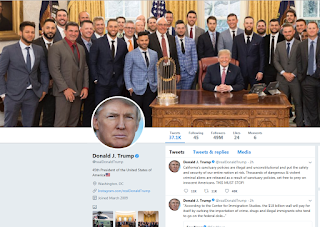
Professor Angela Smith has recently given a paper at the 'Approaches to Discourse' conference at Georgetown University (Washington DC). She spoke on the concept of hypermasculinity, which was first theorised in the early 1980s. At that time masculinity was often perceived as being under threat from the great advances in gender equality made following the arrival of Second Wave Feminism.  Angela argued that in the last five years we have seen a rise in the performance of hypermasculinity on the national stage, often aligned with right wing politics and a heightened sense of national identity in face of a perceived over-reaching of liberalism.  Angela's paper explored how some politicians use social media to promote their messages, side-stepping the otherwise regulating voice of the mainstream media. She looked at tweets from the personal account of Donald Trump to offer an explanation for at least part of the appeal of the ‘Make America...

North East students and the Great War

Image
Dr Sarah Hellawell will be speaking on the theme of 'Students in the North East of England and the Aftermath of the Great War' at an event held by the North East Labour History Society . She will explore the impact of the First World War on student life in the North-East, shedding light on the student-led initiatives to foster a greater sense of internationalism during the interwar years. This research is part of the ‘ British Ex-Service Students and the Rebuilding of Europe Project, 1918-1922 ′ led by academics at Northumbria, UCL and Sunderland Universities in connection with the National Union of Students and the North-East branch of the Workers’ Educational Association . It has been funded by the Arts and Humanities Research Council’s WWI Engagement Centre at the University of Hertfordshire.   April 3rd 2018 at 7pm Old George Inn Old George Yard Newcastle, NE1 1EZ

Gender in 'crisis', everyday sexism and the Twittersphere

Image
A new volume of essays entitled Crisis and the Media  features a chapter by Professor Angela Smith . In it, she explores how rejections of claims for equality are represented in the technology of the twenty-first century, but at the same time embody the language of a pre-feminist world and can thus be seen to at once empower and restrict feminist discourse. In this way, the crisis in gender relations is one that emerges in the 1990s in Westernised contexts and continues to develop into the twenty-first century, contributing to the emergence of a Fourth Wave of feminist action. As such, 'crisis' is employed to explore how various small events, seemingly insignificant in isolation, have been raised to public notice through social media to enhance the emergence of Fourth Wave Feminism in the last ten years. Smith, A. 2018. 'Gender in "crisis", everyday sexism and the Twittersphere.' In Patrona, M. (ed) Crisis and the Media . Amsterdam: John Benjamins, pp.231-260...

The changing presentation of execution in Newcastle

PhD candidate Patrick Low has published an article on the changing presentation of punishment, in particular execution. This topic has been at the heart of much criminal historiography. However, little work has been done to examine the transition outside of London. Newcastle offers a fascinating perspective on any national picture of capital punishment, as it adopted changes far later than most, including close neighbours like Durham. In this article - which appears in Law, Crime & History - Patrick questions why so late a transition occurred and what the motivating factors were. Focusing on executions between 1844 and 1863 it shows that far from being led by London, the decisions were largely reactive to immediate crises, chief amongst them an unruly crowd, and not underpinned by any ideological bent. In short, it will argue for caution in speaking of a unified national change in punishment when even to speak of a regional one is problematic.   Read 'The changing p...

Languages and TESOL research seminar

Image
Dr Steve Cannon In this Languages and TESOL research seminar, Dr. Steve Cannon (Faculty of Arts and Creative Industries, University of Sunderland) will be addressing the topic of awards ceremonies. These events have received little attention from Film Studies academics, most often represented simply by listings of winners in general histories. Quite apart from their marketing role for the industry as a whole, and promoting (and sometimes reviving) particular films, awards ceremonies are also themselves a space for performance and popular entertainment, reflected in their lengthy primetime broadcast slots.   In his paper, entitled 'The Politics of the Awards Ceremony: The ‘Goya’ Awards of the Spanish Film Academy, 2003 and 2004',  Steve will analyse the ways in which ceremonies also offer a space for political statements and mobilisations, echoing and expressing wider social and political struggles but also intervening in them in specific and sometimes organised ways. ...

Cross-discipline research seminar

School of Culture PhD student Malik Alkhawaldeh will be speaking at the next Cross-discipline research seminar in the series. His topic is ecocriticism in Assia Djebar's Children of the New World , Tayeb Salih's Season of Migration to the North and Fadia Faqir's Pillars of Salt . It takes place on Thursday 22nd February at 2pm (there will also be two other talks from research students from Business and Pharmacy).

Dr Sarah Hellawell joins School of Culture

Image
Dr Sarah Hellawell The School is pleased to welcome to its ranks Dr Sarah Hellawell, who has been appointed Lecturer in Modern British History. Before joining us Sarah taught at Northumbria University, where she also completed her doctoral research. Her PhD examined the British Women’s International League (WIL), an organisation that campaigned for peace, disarmament and international law, alongside goals for women’s rights. Aspects of this research have been published in Women’s History Review and in a forthcoming book chapter for an edited collection on the history of the Union of International Associations.  In 2017, Sarah was Research Associate on the ' British Ex-Service Students and the Re-building of Europe Project, 1919-1926 '. She conducted archival research in London and the North-East of England on the history of student activism after the First World War.  Funded by the AHRC World War One Engagement Centre at the University of Hertfordshire and led by academics a...

Academic exchange to India

Image
Dr Geoffrey Nash has recently visited the Aligarh Muslim University under an academic exchange programme undertaken as part of the Sir Syed Bicentenary celebrations. He engaged around 110 AMU faculty members and research scholars for workshops and tutorials on academic writing. The English Department also organized a three-day special lecture series delivered on 17th, 19th and 22nd of January. In the lecture, ‘From Postcolonialism to Islamophobia: An Academic’s Research Trajectory’, Dr Nash traced his journey as a scholar aiming to understand the East. In ‘Postcolonial Translation: The Arabic and the Anglophone Arab Novel’, he focused on the publishing industry and explicated how fiction writers from Arab countries struggle to get a wider audience for their works. In the last lecture on ‘Post 9/11 Writing and Islamophobia: Martin Amis’s Last Days of ‘Muhammad Atta’”, discussion focused on the problematic manner of representation of the mind of an ‘Islamic Fundame...